The course will offer an introduction to the mathematical theory of computation, with a focus towards understanding its relationship with mathematical proofs. The goals of the course are threefold:
- To explain what is a computer, why and how computers were invented, to promote in the student the ability to think computationally and algorithmically.
- To explain to the students the basics of computational complexity: how does one classify mathematical problems by how hard they are to solve? For example, in games and puzzles, in what precise sense can we say that chess is harder than sudoku? That sudoku is harder than a jigsaw puzzle? That a jigsaw puzzle is harder than solving a linear equation…
- To understand why computers are so intimately related with mathematical proofs. To be able to think about proofs as an object of study, what they are, what are their limitations and surprising capabilities.
Time & Place.
- Exercise sessions will happen every Monday, 16:30-18:30 (yes, one extra hour, you don’t have to attend if you prefer not to), in room 6.2.38.
- Theory lectures happen on Tuesdays, 16:30-18:00 (schedule has changed), in room 6.2.38.
Prerequisites. No prior knowledge of Computational Complexity will be assumed, but the pace will be fast. Past experience with programming, algorithms, and/or proofs will help a lot. Basic combinatorics, probability theory, and knowledge of finite fields will be necessary for the course material: we will not teach it during class, but exercises and reading guides will be given for these topics.
People
- The course is organized by Bruno Loff, who will teach the theory lectures. Contact him for questions about course structure, evaluation, etc.
- Exercise sessions are taught by Francesca Ugazio. Contact her for questions about homework.
Method & Syllabus
Classes & Study Materials. You will be given practice exercises with solutions, and homework exercises.
Evaluation Method. Weekly Homework gives multiplicative bonus (10% or 20%) on the test scores. Evaluation is via two tests or an exam:
- The first test happens during the semester.
- On the first exam date the exam will have two parts, one corresponding to test 1, and another corresponding to test 2. You can do either one or both (e.g. do part 2 and do part 1 to try to improve your first test score).
- This is repeated on the second exam date.
The books we will use:
Computational Complexity, A Modern Approach, by Sanjeev Aurora and Boaz Barak.
Part 1. Computability and the Classical notion of Proof
Where we will study how and why the computer was invented.
- The invention of the computer: Turing’s machines.
- Implementation of many algorithms on Turing machines.
- Other models of computation: Random Access machines, baby python, Godel-Herbrand recursive functions. Proofs of equivalence/simulation.
- Universal Turing machines and programs. The Church-Turing thesis.
- Unsolvable problems. The Halting problem and many others.
- First order logic, and Godel’s first incompleteness theorem (in 1 week!).
- Recursively enumerable problems, and a problem which is not recursively enumerable. The arithmetical hierarchy.
Part 2. Computational Complexity, which allowed for radical new notions of proof
- Computational complexity: measuring time. The class P.
- Non-deterministic Turing machines: the P vs NP-problem.
- The Levin-Cook theorem. NP-completeness of many problems.
- Hierarchy theorems. The BGS relativization barrier.
- PSPACE-completeness
- Randomized algorithms: P vs BPP, and more.
- The polynomial hierarchy.
- The complexity of proofs: Interactive proofs, MA, AM, etc, all the way to IP = PSPACE.
- (Time permitting) Zero-Knowledge Proofs
- (Time permitting) Probabilistically-verifiable proofs.
Class Summaries, Reading Guides, Exercise Sheets and Homework
- Week 01a. Review exercises. Ex01 (with solutions),
- Week 01b. The invention of the computer.
- Week 02a. Programming Turing’s machine. Exercise Sheet 02 (some solutions)
- Week 02b. Other models of computation, the universal machine, the halting problem.
- Week 03. Formalizing proofs. Godel’s first incompleteness theorem.
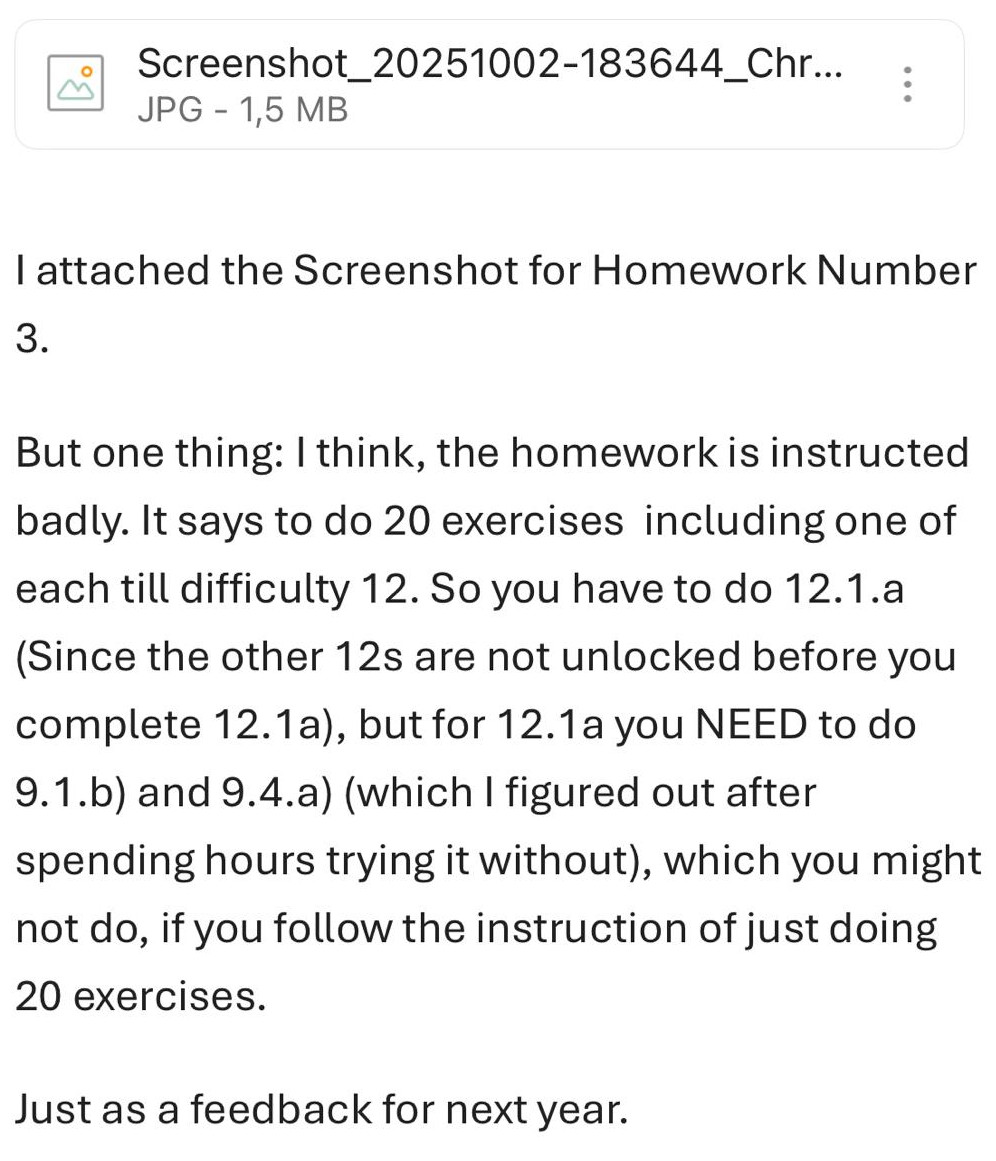
- Homework for week 3: Solve 20 exercises in the QED app. You can choose any 20, but you must solve at least one in every section up to and including section 12. Send Francesca a screenshot by Monday before her class.
- A colleague had this tip to share about the homework:
- Week 04. Reductions and the arithmetical hierarchy.
- Week 05. P, NP.
- Week 06. Time hierarchy. Cook-Levin.
- Week 07. Non-deterministic machines, PSPACE.
- Week 08. Savitch’s theorem. The BGS relativization barrier.
- Week 09. Randomized algorithms – BPP, ZPP, RP, coRP.
- Weeks 10 and 11. Cryptography, all the way to the Goldreich-Levin theorem.
- Week 12. Interactive Proofs (by Suhail).
- Week 13. Probabilistically-Checkable Proofs (by Francesca).
- ALL EXERCISE SHEETS, HOMEWORK, and LECTURE NOTES are now in this link! (easier to update)